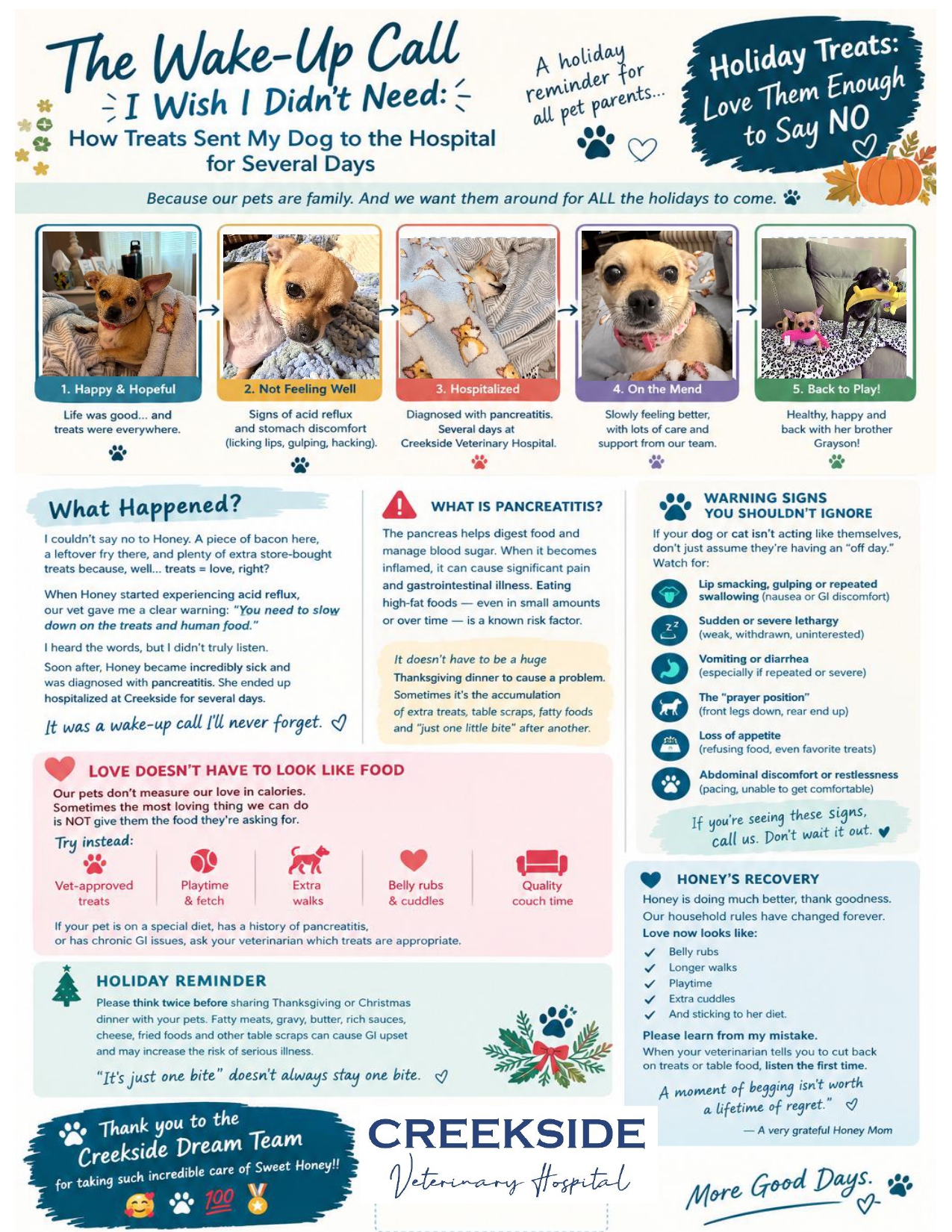

How Treats Sent My Dog to the Hospital for Several Days
Gasp! 😱 How is it already October?!
Before we know it, the holidays will be here — which means family gatherings, Thanksgiving dinners, Christmas parties, holiday baking… and lots of opportunities for our pets to convince us that they absolutely deserve just one little bite. 🥓 🧀 🍗
We’ve all been there.
Those big, soulful eyes staring up at you from underneath the kitchen table. 🥺 🐶
For a long time, I couldn’t say no to my dog, Honey.
A piece of bacon here. 🥓
A leftover French fry there. 🍟
And plenty of extra store-bought treats because, well… treats = love, right?
Unfortunately, I learned the hard way that sometimes loving our pets means saying no.
💔 THE WARNING I DIDN’T TAKE SERIOUSLY
Honey had started experiencing signs of acid reflux and stomach discomfort — smacking her lips, gulping, and occasionally hacking.
Our veterinarians at Creekside gave me some very clear advice:
“You need to slow down on the treats and human food.”
I heard the words.
But I didn’t truly listen.
I thought a few extra treats couldn’t hurt. I figured she was simply a little sensitive.
I was wrong.
Not long afterward, Honey became incredibly, terrifyingly sick.
She was diagnosed with pancreatitis and ended up hospitalized at Creekside Veterinary Hospital for several days.
Watching your pet feel that sick is heartbreaking. 💔
And when you realize that something you were doing because you thought you were showing them love may have contributed to their illness?
That’s a wake-up call you don’t forget.
🩺 WHAT IS PANCREATITIS?
The pancreas plays an important role in digestion and blood sugar regulation. When the pancreas becomes inflamed, it can cause significant abdominal pain and gastrointestinal illness.
Dietary indiscretion — especially eating rich, fatty foods — is one recognized risk factor for pancreatitis in dogs.
And here’s the important part:
It doesn’t have to be a huge Thanksgiving dinner to cause a problem.
Sometimes it’s the accumulation of extra treats, table scraps, fatty foods and “just one little bite” after another.
That’s why your veterinarian may recommend limiting treats or avoiding certain foods altogether — particularly if your pet has already experienced gastrointestinal problems or pancreatitis.
🚨 KNOW THE WARNING SIGNS
Honey taught us to pay much closer attention to subtle changes.
If your dog or cat isn’t acting like themselves, don’t just assume they’re having an “off day.”
Watch for:
🐾 Lip smacking, gulping or repeated swallowing
These can be signs of nausea or gastrointestinal discomfort.
🐾 Sudden or severe lethargy
Not just being sleepy after a long day — but seeming unusually weak, withdrawn or uninterested in normal activities.
🐾 Vomiting or diarrhea
Especially if it is repeated, severe, or accompanied by other symptoms.
🐾 The “prayer position” 🙏 🐶
Front legs and chest lowered toward the ground with the rear end elevated can be a sign of abdominal pain.
🐾 Loss of appetite
A pet who suddenly refuses food — especially a normally food-motivated pet — deserves attention.
🐾 Abdominal discomfort or restlessness
Pets may pace, repeatedly change positions, or seem unable to get comfortable.
If you’re seeing these signs, don’t wait it out if your pet seems significantly ill. Give us a call. ❤️
💗 LOVE DOESN’T HAVE TO LOOK LIKE FOOD
This may have been the hardest lesson for me.
It’s so easy to equate feeding with loving.
We give treats when we’re happy to see them.
We give treats when they’re being good.
We give treats because they’re begging.
We give them a bite because they looked SO CUTE. 🥺
But our pets don’t measure our love in calories.
Sometimes the most loving thing we can do is not give them the food they’re asking for.
Instead, try:
🦴 A veterinarian-approved treat
🏸 A game of fetch
🐕 An extra walk
❤️ A belly rub
🛋️ Some quality couch time
🧡 A little extra attention
And if your pet is on a special diet, has a history of pancreatitis, or has chronic gastrointestinal issues, ask your veterinarian which treats are appropriate.
🎄 HOLIDAY REMINDER: SHARE THE LOVE, NOT THE PLATE
As we head into the holiday season, this is your friendly Creekside reminder:
Please think twice before sharing delicious foods with your pets.
Fatty meats, gravy, butter, rich sauces, cheese, fried foods and other table scraps can cause gastrointestinal upset and may increase the risk of serious illness in some pets.
And remember — “It’s just one bite” doesn’t always stay one bite. 🥺
If your entire family is visiting, make sure everyone knows the rules before the begging begins!
💗 Because pets are family. And we want them around for ALL the holidays to come.
Honey is doing much better, thank goodness. 🙏 🐾
But our household rules have changed forever.
Love now looks a little different.
It looks like belly rubs.
Longer walks.
Playtime.
Extra cuddles.
And sticking to the diet her veterinary team recommended.
Please learn from my mistake.
When your veterinarian tells you to cut back on treats or table food, listen the first time.
A moment of begging isn’t worth a lifetime of regret.
And to the Creekside Dream Team — thank you for taking such incredible care of Sweet Honey. 💗 🐾
More Good Days. That’s what we’re all working toward. 💙
— Angie B, CCR and Honey’s Very Grateful Mom